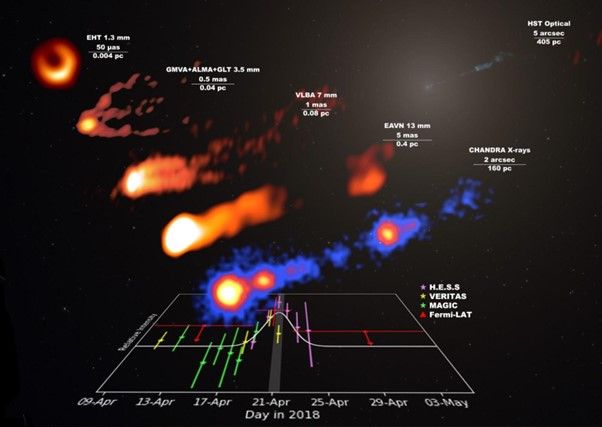
M87’s powerful jet unleashes rare gamma-ray outburst
In April 2019, the Event Horizon Telescope (EHT) Collaboration scientists, including scholars from the Anton Pannekoek Institute for Astronomy of the University of Amsterdam, released the first image of a black hole in the galaxy Messier 87 (M87), and since then have been busy imaging several other active galactic nuclei. The same Collaboration has been coordinating campaigns almost annually ever since, and have just released the results of their second campaign on M87, where they detected a spectacular flare at multiple wavelengths from the powerful relativistic jet emanating from the very centre of the same galaxy. Also known as Virgo A or NGC 4486, M87 is the brightest object in the Virgo cluster of galaxies, the largest gravitationally bound type of structure in the universe. Led by the EHT multi-wavelength working group that coordinates such campaigns, the study presents the data from the second EHT observational campaign conducted in April 2018, involving over 25 ground-based and space-based telescopes. The authors report the first observation in over a decade of a high-energy gamma-ray flare (detecting photons up to thousands of billions of times the energy of visible light) from the supermassive black hole M87* after obtaining nearly simultaneous spectra of the galaxy with the broadest wavelength coverage ever collected.